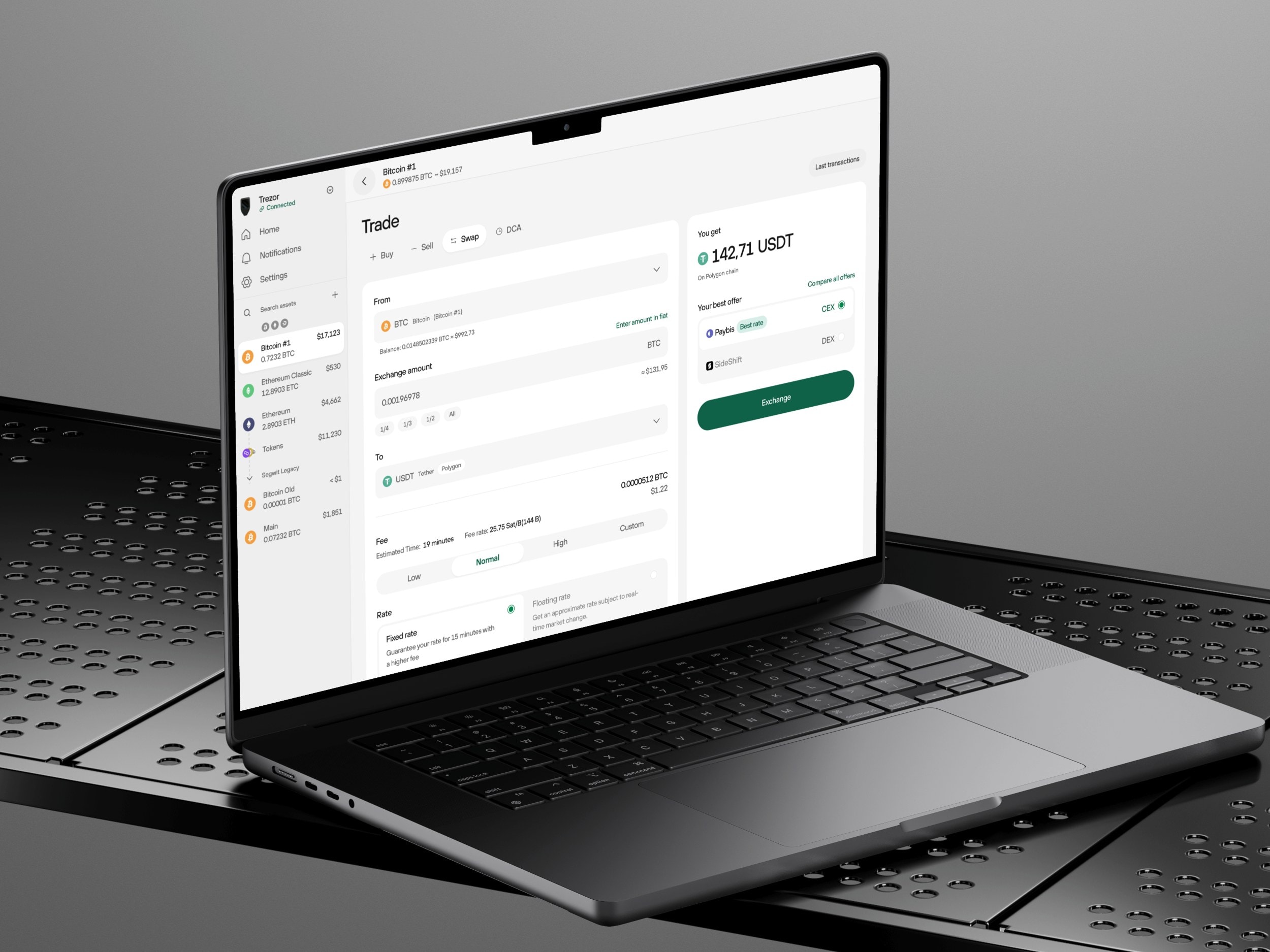
Simplifying setup for an automated Bitcoin strategy in Invity
In Invity, a Bitcoin app from the Trezor family, the Auto Buy strategy has an adaptive variant — Plus — that buys more when the price is low, less when it's high. But the setup asked too much of people. My job was to make it ask less.
- Organization
 Invity
- Role
- Product Designer
- Market
- Europe B2C
- Timeline
- 2024–2026
Context
An adaptive strategy few competitors match
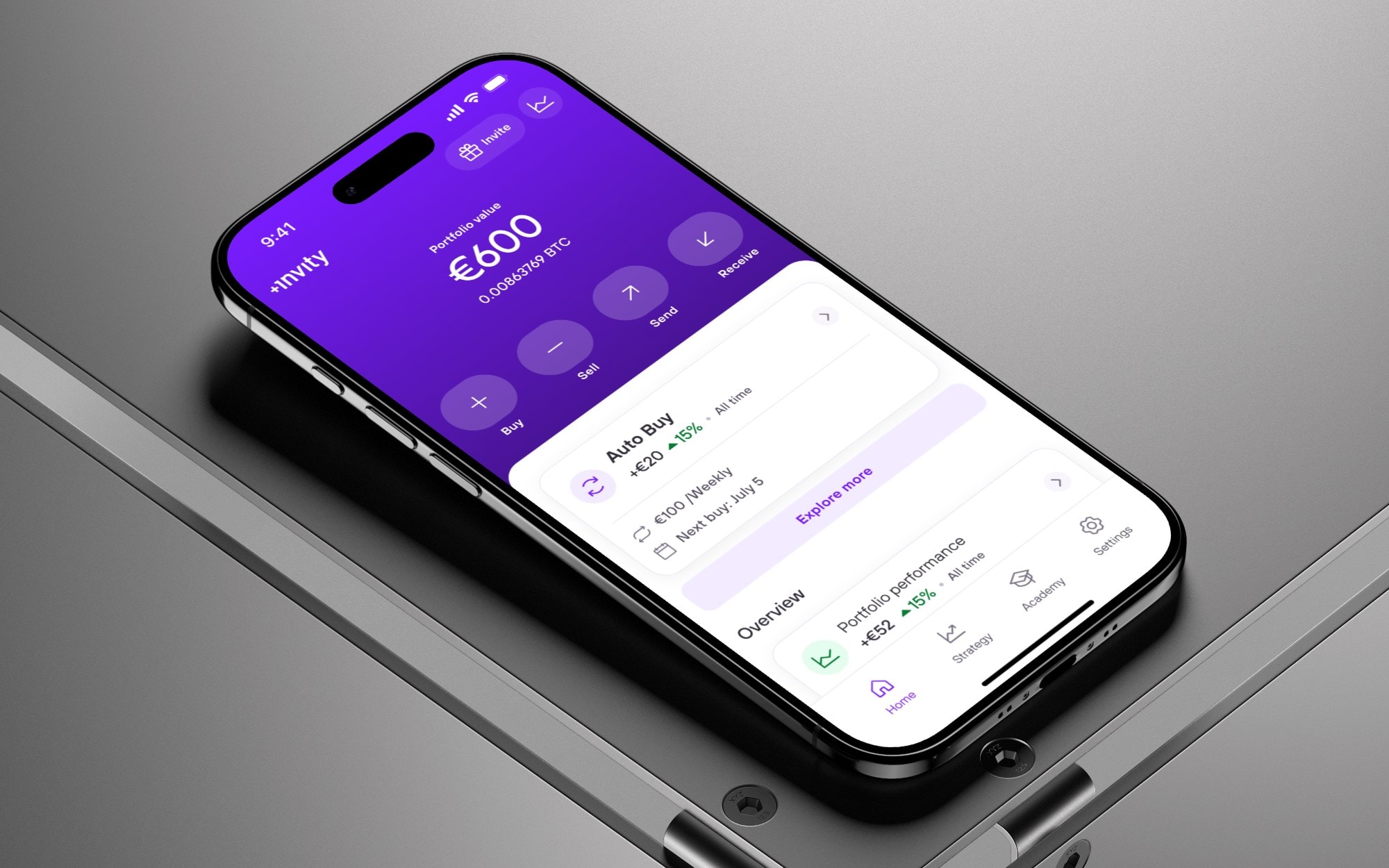
The product — Invity's recurring buy, Auto Buy, has two variants: standard buys a fixed amount every time; Plus adapts, buying more when the price sits below its long-term average.
The business case — a genuine differentiator, and recurring revenue on every buy. Invity is MiCA-licensed, built by SatoshiLabs — the group behind Trezor.
The catch — the value only lands if people understand Plus enough to switch it on. And the road there is the same for everyone: choose a strategy, then configure it.
My role
Within the product team, I owned the user-facing layer — the full experience of choosing and setting up the strategy, from research to handoff.
Problem 1
Information overload before the strategy choice
The problem kept surfacing in the support channel: people struggling to understand the strategy.
The original flow opened with a full historical comparison of Auto Buy and Plus — every detail became required reading before the first tap. That one screen was doing two jobs at once:
Explaining the strategies — how each one works and how they differ, backed by historical performance
Capturing the decision — the same screen carried the actual selection
Solution 1
Choose first, details later
The fix was reordering, not cutting: the choice comes first — the comparison, the lesson, the strategy mechanics all moved one tap deeper. Anyone already decided can pick and go; anyone who wants to dig in still can. One constraint shaped the structure: it had to work for more than one strategy pair.
The decision — the app doesn't persuade. Motivation moved to the website and marketing; the setup keeps one job: a clear choice, simply configured.
The price — past performance, our strongest argument, left the moment of choice. What remains is one label: “Stack more BTC.”
The risk — the mechanism now has to explain the value that performance used to sell. Whether it does is still being measured.
Zoom out from the screen to the whole flow: the old one taught in two steps before the choice. The new one relocates — nothing deleted.
Three rounds, one direction — less teaching, more choosing. Each went through fast internal feedback, colleagues outside the product team included; speed of shipping set the pace.
That fixed the choice. One step deeper, the configuration screen had its own problem.
Problem 2
A setup screen still trying to convince
By this point the user has already decided — they picked the strategy one screen back. But the setup screen kept selling: a five-year return, last Monday's buy.
Persuasion doing a job that was already done — while the actual job here, configuring the strategy, got no help at all.
Solution 2
Feedback in the moment
The screen now does one job: help you configure. History came off — what replaced it is below.
Live range banner — reacts as you move the slider, in plain language about what the algorithm can do with your range; never advice about what to invest.
Your real first buy — instead of a past return: an actual purchase, calculated from the 120-week average the moment you activate.
Frequency unlocked — buys are no longer fixed to Mondays; you choose the interval.
Result
A setup that helps instead of sells
Both fixes are one idea: the setup asks less and shows more — how the strategy works instead of what it returned. The screens carry less, and the adaptive chart with its animation does the explaining that paragraphs used to do — you see the strategy buy more on dips instead of reading about it.
The pattern outlived the project — the same choose-first structure was adopted for Turbo Buy and Turbo Buy Plus, Invity's flagship strategy pair.
Measured by — setup completion and adaptive-strategy activations. The numbers aren't in this case study yet; when they land, they'll be real ones.